

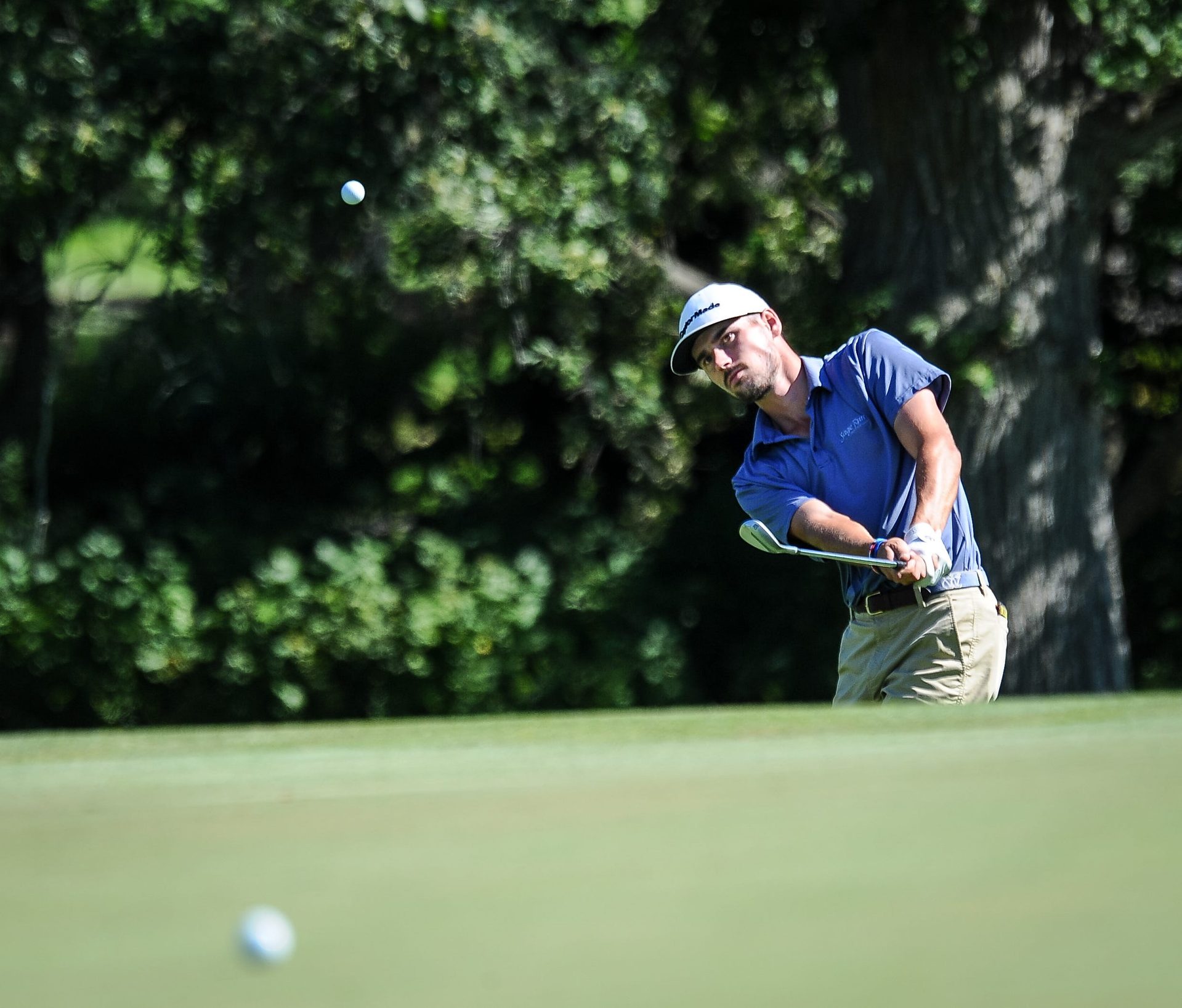

The most unlikely path to the PGA Tour does not start on a manicured practice range. It starts in a town of 182 people where the only traffic signal is a caution light. It also starts after a battle with cancer that almost ended a career before it began. The top 20 players on the Korn Ferry Tour just secured their spots for the big leagues, and the stories behind these graduates defy the usual script of wealthy juniors and private academies. Two of these new members stand out for reasons that have nothing to do with their swing speed.
From a Single Caution Light to the Big Stage
Hunter Eichhorn grew up in Carney, Michigan, a place so small it barely registers on a map. The last U.S. Census recorded a population of just 182 people there. So what is it like growing up in such an isolated spot? “We have one caution light, actually,” Eichhorn said. He learned the game at Wild Pines, a public nine-hole course where the longest hole measures only 392 yards. The cost to play is a flat $15, paid in cash at an honor box. His grandfather, Steve Pipkorn, taught him to play in a scramble format to keep things moving. “We did it so we could move along and didn’t have to worry about bad shots,” Eichhorn said.
That simple approach led to a dominant college career at Marquette, where he won six times and broke school scoring records. He finished his first Korn Ferry season with nine top-10 finishes to clinch his card. Now he faces the best players in the world with a clear goal in mind. “I’m excited to compete against the best in the world,” Eichhorn said. “The goal would be winning. The goal would be making the Tour Championship.”
Surviving Cancer and Finding the Long Road
While Eichhorn came from a tiny town, Alvaro Ortiz came back from a life-threatening illness. The 30-year-old from Mexico is a cancer survivor who just earned his spot on the PGA Tour. Carlos, his brother, was preceded at the Masters when he won the Latin American Amateur in 2019, yet reaching the main tour required far more time. “I’ve always known I was going to make it,” Ortiz said. “Through the years, you’re starting to doubt. When is it going to happen? Is it going to happen?” He noted that the business is so result-oriented that players often need to step back and see the bigger picture of their journey.
Another graduate, 19-year-old Blades Brown, turned pro as a high school junior. History now records him as the youngest Korn Ferry Tour graduate. These diverse backgrounds show that the gate to the top level is not just for those with deep pockets or perfect starts. The leading 20 players secured their tickets and had three days to celebrate before heading to PGA Tour headquarters in Ponte Vedra Beach for orientation. An agenda and media training made them feel like college freshmen, per the Associated Press.
A New Reality for the Professional Game
The pressure to perform is high, and the financial stakes have shifted dramatically in recent years. Former PGA Tour pro Matt Every argues that the new structure offers a safety net for those who struggle. He believes the minimum $4 million purses in the planned Challenger Series give players a real chance to rebuild. “We’ll see the first year but I think we should be patient and give it some time. I think for the professional golfer this is a win overall. It really is,” Every said in an interview with Yahoo Sports.
However, the path remains narrow for those who leave the main tour. Golf legend Gary Player has long warned that players cannot have it both ways if they jump between tours. He told Sky Sports News that while money is a valid reason to play elsewhere, the rules are clear. “But…you can’t have both tours, you can’t do that, it’s not going to be allowed according to the rules, as far as I know,” Player said. For the new graduates like Eichhorn and Ortiz, the rules are simple: make the cut, play well, or face the consequences. The tour is watching, and the window to prove oneself is open.
