
The Rain Changes Everything
Golfers usually look at spin numbers when buying a new wedge. On a dry day, the results look almost the same. MyGolfSpy found that every wedge in their 2026 test landed between 6,729 and 7,217 rpm. That tiny 488-rpm spread means nothing on a sunny afternoon. But add a little water to the mix and the whole field breaks apart. The spread jumps from 488 rpm to more than 3,700. Some clubs give up almost nothing while others lose more than half their spin. That is the difference between a clean stop and a skidding mess.
This matters most for early tee times or rainy climates. The dew on the fairway can turn a trusted scoring club into a liability. You do not lose distance in the rain. For almost every wedge examined, the carry distance remained within approximately one yard of the dry baseline figure. The problem is the stop. On wet shots, the leading wedges rolled out about two feet, mirroring their performance on dry surfaces. The bottom three went from two feet to somewhere between seven and eleven feet. That is a huge gap on a 50-yard shot.
The One Perfect Performer
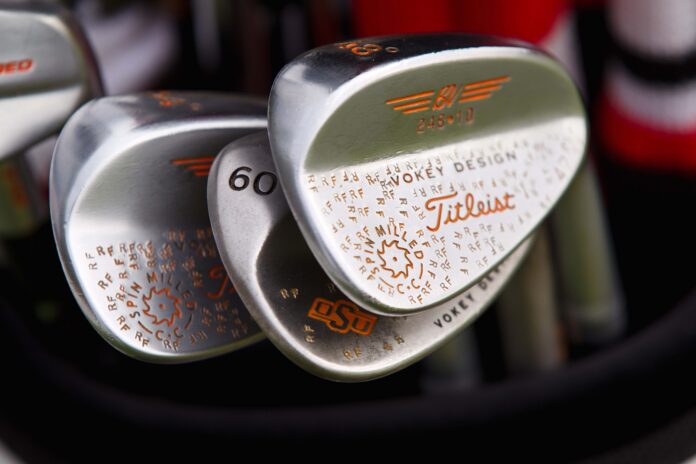
One wedge did something no other model managed in the test. The Titleist Vokey SM11 kept all its spin. According to MyGolfSpy, the dry spin was 6,857 rpm and the wet spin was 6,860 rpm. The entire field contains no other retention figure that reaches 100 percent. This is not a lucky break. The face clears the water so the ball grips the grooves instead of skidding up them. Between wet and dry shots, the Vokey’s launch angle shifted by merely a tenth of a degree. That consistency is what every player needs from a scoring club.
Other top performers held up well too. The Cleveland RTZ Tour Rack kept 97.9 percent of its spin. The Cleveland CBZ held 97.2 percent. Kirkland Signature GEN 3 Forged came in at 96.8 percent. These clubs behave the same way whatever the conditions. They do not hand you a different club and hide the change. Golfers can trust them when the course gets wet.
Clubs That Fail in the Rain
At the other end of the list, the results get ugly fast. The Tanso Golf Tour-W dropped to 55.7 percent retention. Performance Golf ONE.1 fell to 48.6 percent. Ballistic Forged Proto lost more than half its spin, dropping to just 46.0 percent. When the face cannot clear water, the ball launches higher and spins less. The Tanso launch angle climbed 7.5 degrees while the Ballistic climbed 7.6 degrees. Performance Golf climbed a massive 8.8 degrees. That is a fundamentally different shot that releases when it lands.
Most golfers do not see this problem until they are on the course with wet grass. They think their wedge is fine until they miss a short shot by a wide margin. A wedge is a scoring club and it has to be predictable. The data from MyGolfSpy shows that only the Titleist Vokey SM11 kept its promise in the wet. Everyone else gave something up. If you play in the morning or live where it rains often, the choice is clear. The numbers do not lie.